
Harnessing Quantitative Scores to Combat Bias in Investing : SmartSkor
Harnessing Quantitative Scores to Combat Bias in Investing : SmartSkor

Harnessing Quantitative Scores to Combat Bias in Investing
Most investors believe they are making rational decisions. They research stocks, track the news, and monitor their portfolios closely. Yet study after study — across markets spanning North America, Europe, and emerging economies — arrives at the same uncomfortable conclusion: the vast majority of individual investors systematically underperform simple, passive benchmarks. In our own analysis of hundreds of millions of retail trades, more than 90 percent of investors earned Sharpe ratios below their domestic market index. The problem is not laziness or lack of effort. It is something more fundamental: the tools investors use to make decisions are no match for the biases embedded in how human beings naturally think.
Quantitative scoring — the practice of translating empirical finance research into structured, forward-looking signals — is one of the most powerful remedies available. This post explains what that means, why it works, and how it can change the way investors engage with markets.
The Limits of Intuition
Human beings are not naturally suited to financial decision-making. We are wired to respond to narratives, follow trends, and overweight vivid recent experiences. These tendencies served our ancestors well in environments where pattern recognition and social conformity were survival advantages. In financial markets, they are reliably costly.
Consider what behavioral finance research has documented over the past three decades. Investors systematically sell winning stocks too early and hold losing stocks too long — the disposition effect. They trade far more frequently than is justified by their information, eroding returns through both transaction costs and timing errors. They concentrate their portfolios in familiar names rather than diversifying intelligently. And they gravitate toward high-volatility, attention-grabbing stocks — lottery-type securities — that empirically underperform the market over time.
These are not fringe behaviors. They are the norm. When we analyzed over millions of trades by retail investors in different geographies around the world, we found that the stocks investors bought declined in the subsequent 30 days relative to the market, while the stocks they sold subsequently outperformed. Investors were not merely uninformed — they were systematically misinformed, trading consistently in the wrong direction relative to what the evidence suggested.
The core problem is that human intuition tends to chase signals that feel informative but carry little actual predictive power: recent performance, news salience, brand familiarity. Meanwhile, the variables that *do* predict returns — valuation discipline, profitability quality, earnings credibility, information diffusion dynamics — are harder to perceive intuitively and require systematic processing.
What Quantitative Scoring Does Differently
A well-designed quantitative score inverts this problem. Rather than responding to what *feels* important, it is built around what *empirically predicts* future returns —variables identified through decades of peer-reviewed research in asset pricing and behavioral finance.
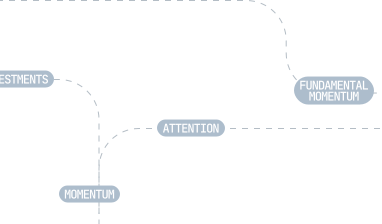
The SmartSkor framework is an example of this approach applied to Turkish equities. It aggregates hundreds of firm-level characteristics across six broad categories: valuation (are investors overpaying for this stock?), momentum (what is the trend in returns adjusted for risk?), profitability (how efficiently does the firm generate earnings?), investment discipline (is management deploying capital wisely?), attention and sentiment (is the stock inflated by retail enthusiasm?), and informational complexity (how opaque or contested is the firm's financial reporting?).
Each variable entering the composite has two prerequisites: a published theoretical justification and demonstrated empirical validity. No signal is included because it happens to work in a particular back test. Every inclusion reflects structural knowledge about how risk is priced, how information diffuses, and how investor behavior creates predictable mispricings.
The output is a single forward-looking score — an expected-return forecast —that is updated regularly and fully decomposable. An investor can see not just what score a stock receives, but *why*: which components are driving it, and in which direction.
Penalizing the Traps, Rewarding the Overlooked
One of the most important features of a well-designed quantitative score is what it *penalizes*. High volatility, extreme recent momentum, elevated retail attention, and idiosyncratic distress — all characteristics that attract retail buyers —reduce the expected-return estimate. This is not arbitrary. These characteristics are empirically associated with overvaluation and subsequent underperformance.
Conversely, the scores reward characteristics that investors tend to neglect: firms with strong gross profitability but low media coverage, securities with healthy sales-to-price ratios that have not attracted speculative inflows, companies with transparent reporting and disciplined capital allocation. These are the kinds of opportunities that a human investor scanning headlines or chasing momentum would likely overlook.
In this sense, the score functions as a corrective filter. It systematically redirects attention away from the salient and toward the neglected — which, in equity markets, tends to be where the risk-adjusted returns actually are.
From Ranking to Decision Support
A quantitative score is most powerful when it is embedded in the actual decision-making process, not consulted occasionally as an afterthought. When an investor is considering buying a high-momentum, high-volatility stock that ranks poorly on expected returns, the score can provide an evidence-based counterweight. When an investor is reviewing a fund, a bottom-up scoring of underlying holdings can reveal whether the fund's past returns reflect genuine skill or a fortunate exposure to sentiment-driven securities.
This is the logic behind SmartFundSkor, which computes a holdings-weighted average of SmartSkor estimates for each equity fund. Rather than evaluating funds by historical performance — a metric heavily contaminated by luck, survivorship bias, and market-cycle timing — it asks a more tractable question: given what the fund currently holds, what does the evidence suggest about its future risk-adjusted performance? Funds that hold high-expected-return securities score well; funds that closet-index or speculate in lottery-type stocks score poorly, regardless of what their track record shows.
The Deeper Logic
Quantitative scores are not a replacement for thinking. They are a discipline imposed on thinking — a way of ensuring that the variables that *actually* predict outcomes receive appropriate weight, while the variables that merely *feel*predictive are held to a higher standard of evidence.
For retail investors, this matters enormously. Without a structured filter, every investment decision is vulnerable to the full repertoire of cognitive shortcuts that evolution has built into human judgment. With one, the investor has a tool that continuously checks intuition against evidence — and flags the cases where the two diverge most sharply.
The goal is not to make investing emotionless. It is to make sure that emotion does not operate unchecked. When intuition and evidence agree, invest with confidence. When they conflict, the burden of proof shifts — and the investor who respects that shift will, over time, perform materially better than the one who does not.
That is not a hypothesis. It is what the data, across decades and markets, consistently show.
Turn insights into profitable investment decisions with SmartSkor
Move beyond historical rankings, invest based on the forward-looking
quality of publicly traded equities.

momentum